Carnivorous plants are plants that derive some or most of their nutrients from trapping and consuming animals or protozoans, typically insects and other arthropods. Carnivorous plants still generate some of their energy from photosynthesis. Carnivorous plants have adapted to grow in places where the soil is thin or poor in nutrients, especially nitrogen, such as acidic bogs.[4] They can be found on all continents except Antarctica, as well as many Pacific islands.[5] In 1875 Charles Darwin published Insectivorous Plants, the first treatise to recognize the significance of carnivory in plants, describing years of painstaking research.[6][4]

True carnivory is believed to have evolved independently at least 12 times[6][7][8] in five different orders of flowering plants,[9][10] and is represented by more than a dozen genera. This classification includes at least 583 species that attract, trap, and kill prey, absorbing the resulting available nutrients.[11][12]Venus flytrap (Dionaea muscipula), pitcher plant (Cephalotus follicularis), and bladderwort (Utricularia gibba) can be seen as exemplars of key traits genetically associated with carnivory: trap leaf development, prey digestion, and nutrient absorption.[9]
The number of known species has increased by approximately 3 species per year since the year 2000.[13] Additionally, over 300 protocarnivorous plant species in several genera show some but not all of these characteristics. A 2020 assessment has found that roughly one quarter are threatened with extinction from human actions.[14][15]
What makes a plant "carnivorous"
Plants are considered "carnivorous" if they have these five traits:[16]
- capture prey in traps
- kill the captured prey
- digest the captured prey
- absorb nutrients from the killed and digested prey
- use those nutrients to grow and develop.
Other traits may include the attraction and retention of prey.[16]
Trapping mechanisms

Five basic trapping mechanisms are found in carnivorous plants.[17]
- Pitfall traps (pitcher plants) trap prey in a rolled leaf that contains a pool of digestive enzymes or bacteria.
- Flypaper traps use a sticky mucilage.
- Snap traps utilise rapid leaf movements.
- Bladder traps suck in prey with a bladder that generates an internal vacuum.
- Lobster-pot traps, also known as eel traps, use inward-pointing hairs to force prey to move towards a digestive organ.
These traps may be active or passive, depending on whether movement aids the capture of prey. For example, Triphyophyllum is a passive flypaper that secretes mucilage, but whose leaves do not grow or move in response to prey capture. Meanwhile, sundews are active flypaper traps whose leaves undergo rapid acid growth, which is an expansion of individual cells as opposed to cell division. The rapid acid growth allows the sundews' tentacles to bend, aiding in the retention and digestion of prey.[18]
Pitfall traps
Characterised by an internal chamber, pitfall traps are thought to have evolved independently at least six times.[11] This particular adaptation is found within the families Sarraceniaceae (Darlingtonia, Heliamphora, Sarracenia), Nepenthaceae (Nepenthes), and Cephalotaceae (Cephalotus). Within the family Bromeliaceae, pitcher morphology and carnivory evolved twice (Brocchinia and Catopsis).[11] Because these families do not share a common ancestor who also had pitfall trap morphology, carnivorous pitchers are an example of convergent evolution.
A passive trap, pitfall traps attract prey with nectar bribes secreted by the peristome and bright flower-like anthocyanin patterning within the pitcher. The linings of most pitcher plants are covered in a loose coating of waxy flakes which are slippery for insects, causing them to fall into the pitcher. Once within the pitcher structure, digestive enzymes or mutualistic species break down the prey into an absorbable form for the plant.[19][20] Water can become trapped within the pitcher, making a habitat for other flora and fauna. This type of 'water body' is called a Phytotelma.
The simplest pitcher plants are probably those of Heliamphora, the marsh pitcher plant. In this genus, the traps are clearly derived from a simple rolled leaf whose margins have sealed together. These plants live in areas of high rainfall in South America such as Mount Roraima and consequently have a problem ensuring their pitchers do not overflow. To counteract this problem, natural selection has favoured the evolution of an overflow similar to that of a bathroom sink—a small gap in the zipped-up leaf margins allows excess water to flow out of the pitcher.[citation needed][21]

In the genus Sarracenia, the problem of pitcher overflow is solved by an operculum, which is essentially a flared leaflet that covers the opening of the rolled-leaf tube and protects it from rain. Possibly because of this improved waterproofing, Sarracenia species secrete enzymes such as proteases and phosphatases into the digestive fluid at the bottom of the pitcher; Most Heliamphora rely on bacterial digestion alone with the exception of a single species, Heliamphora tatei, which does produce digestive enzymes. The enzymes digest the proteins and nucleic acids in the prey, releasing amino acids and phosphate ions, which the plant absorbs. In at least one species, Sarracenia flava, the nectar bribe is laced with coniine, a toxic alkaloid also found in hemlock, which probably increases the efficiency of the traps by intoxicating prey.[22]
Darlingtonia californica, the cobra plant, possesses an adaptation also found in Sarracenia psittacina and, to a lesser extent, in Sarracenia minor: the operculum is balloon-like and almost seals the opening to the tube. This balloon-like chamber is pitted with areolae, chlorophyll-free patches through which light can penetrate. Insects, mostly ants, enter the chamber via the opening underneath the balloon. Once inside, they tire themselves trying to escape from these false exits, until they eventually fall into the tube. Prey access is increased by the "fish tails", outgrowths of the operculum that give the plant its name. Some seedling Sarracenia species also have long, overhanging opercular outgrowths; Darlingtonia may therefore represent an example of neoteny.

The second major group of pitcher plants are the monkey cups or tropical pitcher plants of the genus Nepenthes. In the hundred or so species of this genus, the pitcher is borne at the end of a tendril, which grows as an extension to the midrib of the leaf. Most species catch insects, although the larger ones, such as Nepenthes rajah, also occasionally take small mammals and reptiles. Nepenthes bicalcarata possesses two sharp thorns that project from the base of the operculum over the entrance to the pitcher. These likely serve to lure insects into a precarious position over the pitcher mouth, where they may lose their footing and fall into the fluid within.[23]
The pitfall trap has evolved independently in at least two other groups. The Albany pitcher plant Cephalotus follicularis is a small pitcher plant from Western Australia, with moccasin-like pitchers. The rim of its pitcher's opening (the peristome) is particularly pronounced (both secrete nectar) and provides a thorny overhang to the opening, preventing trapped insects from climbing out.
The final carnivore with a pitfall-like trap is the bromeliad Brocchinia reducta. Like most relatives of the pineapple, the tightly packed, waxy leaf bases of the strap-like leaves of this species form an urn. In most bromeliads, water collects readily in this urn and may provide habitats for frogs, insects and, more useful for the plant, diazotrophic (nitrogen-fixing) bacteria. In Brocchinia, the urn is a specialised insect trap, with a loose, waxy lining and a population of digestive bacteria.[citation needed]
Flypaper traps

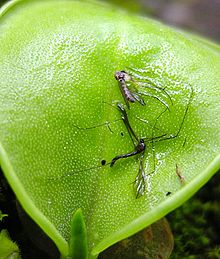
The flypaper trap utilises sticky mucilage or glue. The leaf of flypaper traps is studded with mucilage-secreting glands, which may be short (like those of the butterworts), or long and mobile (like those of many sundews). Flypapers have evolved independently at least five times. There is evidence that some clades of flypaper traps have evolved from morphologically more complex traps such as pitchers.[10]
In the genus Pinguicula, the mucilage glands are quite short (sessile), and the leaf, while shiny (giving the genus its common name of 'butterwort'), does not appear carnivorous. However, this belies the fact that the leaf is an extremely effective trap of small flying insects (such as fungus gnats), and its surface responds to prey by relatively rapid growth. This thigmotropic growth may involve rolling of the leaf blade (to prevent rain from splashing the prey off the leaf surface) or dishing of the surface under the prey to form a shallow digestive pit.
The sundew genus (Drosera) consists of over 100 species of active flypapers whose mucilage glands are borne at the end of long tentacles, which frequently grow fast enough in response to prey (thigmotropism) to aid the trapping process. The tentacles of D. burmanii can bend 180° in a minute or so. Sundews are extremely cosmopolitan and are found on all the continents except the Antarctic mainland. They are most diverse in Australia, the home to the large subgroup of pygmy sundews such as D. pygmaea and to a number of tuberous sundews such as D. peltata, which form tubers that aestivate during the dry summer months. These species are so dependent on insect sources of nitrogen that they generally lack the enzyme nitrate reductase, which most plants require to assimilate soil-borne nitrate into organic forms.[citation needed]

Similar to Drosera is the Portuguese dewy pine, Drosophyllum, which differs from the sundews in being passive. Its leaves are incapable of rapid movement or growth. Unrelated, but similar in habit, are the Australian rainbow plants (Byblis). Drosophyllum is unusual in that it grows under near-desert conditions; almost all other carnivores are either bog plants or grow in moist tropical areas. Recent molecular data (particularly the production of plumbagin) indicate that the remaining flypaper, Triphyophyllum peltatum, a member of the Dioncophyllaceae, is closely related to Drosophyllum and forms part of a larger clade of carnivorous and non-carnivorous plants with the Droseraceae, Nepenthaceae, Ancistrocladaceae and Plumbaginaceae. This plant is usually encountered as a liana, but in its juvenile phase, the plant is carnivorous. This may be related to a requirement for specific nutrients for flowering.
Snap traps
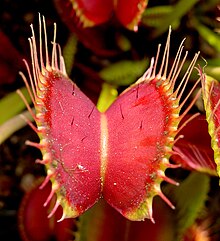

The only two active snap traps—the Venus flytrap (Dionaea muscipula) and the waterwheel plant (Aldrovanda vesiculosa)—had a common ancestor with the snap trap adaptation, which had evolved from an ancestral lineage that utilized flypaper traps.[24] Their trapping mechanism has also been described as a "mouse trap", "bear trap" or "man trap", based on their shape and rapid movement. However, the term snap trap is preferred as other designations are misleading, particularly with respect to the intended prey. Aldrovanda is aquatic and specialized in catching small invertebrates; Dionaea is terrestrial and catches a variety of arthropods, including spiders.[25]
The traps are very similar, with leaves whose terminal section is divided into two lobes, hinged along the midrib. Trigger hairs (three on each lobe in Dionaea muscipula, many more in the case of Aldrovanda) inside the trap lobes are sensitive to touch. When a trigger hair is bent, stretch-gated ion channels in the membranes of cells at the base of the trigger hair open, generating an action potential that propagates to cells in the midrib.[26] These cells respond by pumping out ions, which may either cause water to follow by osmosis (collapsing the cells in the midrib) or cause rapid acid growth.[27] The mechanism is still debated, but in any case, changes in the shape of cells in the midrib allow the lobes, held under tension, to snap shut,[26] flipping rapidly from convex to concave[28] and interring the prey. This whole process takes less than a second. In the Venus flytrap, closure in response to raindrops and blown-in debris is prevented by the leaves having a simple memory: for the lobes to shut, two stimuli are required, 0.5 to 30 seconds apart.[29][30]
The snapping of the leaves is a case of thigmonasty (undirected movement in response to touch). Further stimulation of the lobe's internal surfaces by the struggling insects causes the lobes to close even tighter (thigmotropism), sealing the lobes hermetically and forming a stomach in which digestion occurs over a period of one to two weeks. Once this process is triggered, it cannot be reversed and requires more stimulation to trigger the next steps. Leaves can be reused three or four times before they become unresponsive to stimulation, depending on the growing conditions.
Bladder traps

Bladder traps are exclusive to the genus Utricularia, or bladderworts. The bladders (vesiculae) pump ions out of their interiors. Water follows by osmosis, generating a partial vacuum inside the bladder. The bladder has a small opening, sealed by a hinged door. In aquatic species, the door has a pair of long trigger hairs. Aquatic invertebrates such as Daphnia touch these hairs and deform the door by lever action, releasing the vacuum. The invertebrate is sucked into the bladder, where it is digested. Many species of Utricularia (such as U. sandersonii) are terrestrial, growing in waterlogged soil, and their trapping mechanism is triggered in a slightly different manner. Bladderworts lack roots, but terrestrial species have anchoring stems that resemble roots. Temperate aquatic bladderworts generally die back to a resting turion during the winter months, and U. macrorhiza appears to regulate the number of bladders it bears in response to the prevailing nutrient content of its habitat.[21]
Lobster-pot traps
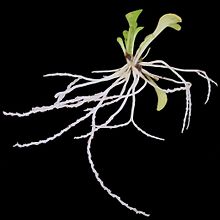
A lobster-pot trap is a chamber that is easy to enter, and whose exit is either difficult to find or obstructed by inward-pointing bristles. Lobster pots are the trapping mechanism in Genlisea, the corkscrew plants. These plants appear to specialise in aquatic protozoa. A Y-shaped modified leaf allows prey to enter but not exit. Inward-pointing hairs force the prey to move in a particular direction. Prey entering the spiral entrance that coils around the upper two arms of the Y are forced to move inexorably towards a stomach in the lower arm of the Y, where they are digested. Prey movement is also thought to be encouraged by water movement through the trap, produced in a similar way to the vacuum in bladder traps, and probably evolutionarily related to it.
Outside of Genlisea, features reminiscent of lobster-pot traps can be seen in Sarracenia psittacina, Darlingtonia californica, and, some horticulturalists argue, Nepenthes aristolochioides.
Combination traps
The trapping mechanism of the sundew Drosera glanduligera combines features of both flypaper and snap traps; it has been termed a catapult-flypaper trap.[31] However, this is not the only combination traps. Nepenthes jamban is a combination of pitfall and flypaper traps because it has a sticky pitcher fluid.
Most Sumatran nepenthes, like N. inermis, also have this method. For example, N. Dubia and N. flava also use this method.
Borderline carnivores
To be defined as carnivorous, a plant must first exhibit an adaptation of some trait specifically for the attraction, capture, or digestion of prey. Only one trait needs to have evolved that fits this adaptive requirement, as many current carnivorous plant genera lack some of the above-mentioned attributes. The second requirement is the ability to absorb nutrients from dead prey and gain a fitness advantage from the integration of these derived nutrients (mostly amino acids and ammonium ions)[32] either through increased growth or pollen and/or seed production. However, plants that may opportunistically utilise nutrients from dead animals without specifically seeking and capturing fauna are excluded from the carnivorous definition. The second requirement also differentiates carnivory from defensive plant characteristics that may kill or incapacitate insects without the advantage of nutrient absorption. Due to the observation that many currently classified carnivores lack digestive enzymes for breaking down nutrients and instead rely upon mutualistic and symbiotic relationships with bacteria, ants, or insects, this adaptation has been added to the carnivorous definition.[33][34] Despite this, there are cases where plants appear carnivorous, in that they fulfill some of the above definition, but are not truly carnivorous. Some botanists argue that there is a spectrum of carnivory found in plants: from completely non-carnivorous plants like cabbages, to borderline carnivores, to unspecialised and simple traps, like Heliamphora, to extremely specialised and complex traps, like that of the Venus flytrap.[19]

A possible carnivore is the genus Roridula; the plants in this genus produce sticky leaves with resin-tipped glands and look extremely similar to some of the larger sundews. However, they do not directly benefit from the insects they catch. Instead, they form a mutualistic symbiosis with species of assassin bug (genus Pameridea), which eat the trapped insects. The plant benefits from the nutrients in the bugs' feces.[35] By some definitions this would still constitute botanical carnivory.[19]
A number of species in the Martyniaceae (previously Pedaliaceae), such as Ibicella lutea, have sticky leaves that trap insects. However, these plants have not been shown conclusively to be carnivorous.[36] Likewise, the seeds of Shepherd's Purse,[36] urns of Paepalanthus bromelioides,[37] bracts of Passiflora foetida,[38] and flower stalks and sepals of triggerplants (Stylidium)[39] appear to trap and kill insects, but their classification as carnivores is contentious.
Two genera of liverwort, Colura and Pleurozia, have sac-shaped leaves that trap and kill ciliates and may digest them.
Digestion
Specialized multicellular secretion glands produce digestive fluid that smother, kill, digest prey and make a solution to assimilate released nutrients.[40] Saccharides are often found in plants that have adhesive traps or plants that use viscous secretion to retain captured prey. The digestion fluid is often nutrient poor and has ions K+, Na+, Ca2+ and Mg2+ (for species in the Nepenthes genera for example), along with numerous proteins which vary across genera. Peroxidases are also involved for some species. The body of the prey is decomposed by a cocktail of hydrolytic enzymes which are stored in sub-cellular compartments or synthesized over and over as needed.[40]
Proteins of digestive fluid include proteases, chitinases (partly destroy exoskeleton of insects), phosphatases, and nucleases.[40]
Evolution
General pattern of independent development in multiple lineages
Charles Darwin spent 16 years growing carnivorous plants, experimenting with them in the greenhouse of his home in Kent, Down House.[6] In his pioneering book Insectivorous Plants (1875) Darwin concluded that carnivory in plants was convergent, writing that carnivorous genera Utricularia and Nepenthes were not "at all related to the [carnivorous family] Droseraceae".[4] This remained a subject of debate for over a century. In 1960, Leon Croizat concluded that carnivory was monophyletic, and placed all the carnivorous plants together at the base of the angiosperms.[10] Molecular studies over the past 30 years have led to a wide consensus that Darwin was correct, with studies showing that carnivory evolved at least six times in the angiosperms, and that trap designs such as pitcher traps and flypaper traps are analogous rather than homologous.[33][9]
Researchers using molecular data have concluded that carnivory evolved independently in the Poales (Brocchinia and Catopsis in the Bromeliaceae), the Caryophyllales (Droseraceae, Nepenthaceae, Drosophyllaceae, Dioncophyllaceae), the Oxalidales (Cephalotus), the Ericales (Sarraceniaceae and Roridulaceae), and twice in the Lamiales (Lentibulariaceae and independently in Byblidaceae).[10] The oldest evolution of an existing carnivory lineage has been dated to 85.6 million years ago, with the most recent being Brocchinia reducta in the Bromeliaceae estimated at only 1.9 mya.[41]
The evolution of carnivorous plants is obscured by the paucity of their fossil record. Very few fossils have been found, and then usually only as seed or pollen. Carnivorous plants are generally herbs, and their traps are produced by primary growth. They generally do not form readily fossilisable structures such as thick bark or wood.[6][9]
Researchers are increasingly using genome sequencing technology to examine the development of carnivorous species and relationships between them. Genetic evidence suggests that carnivory developed by co-opting and repurposing existing genes which had established functions in flowering plants, rather than by "hijacking" genes from other types of organisms.[6][9]
Adaption to extreme habitats
Most carnivorous plants live in habitats with high light, waterlogged soils, and extremely low soil nitrogen and phosphorus, producing the ecological impetus to derive nitrogen from an alternate source. High-light environments allowed for the trade-off between photosynthetic leaves and photosynthetically-inefficient, prey-capturing traps. To compensate for the photosynthetically-inefficient material, the nutrients obtained through carnivory would need to increase photosynthesis by investing in more leaf mass (i.e. growth). Consequently, when there is a shortage of nutrients, sufficient light and water, the capture and digestion of prey has the greatest impact on photosynthetic gains, thus favoring the evolution of plant adaptations which allowed for more effective, efficient carnivory.[19][32]
Due to the required energy and resource allocations for carnivorous adaptations (e.g. the production of lures, digestive enzymes, modified leaf structures, and the decreased rate of photosynthesis over total leaf area), some authors argue that carnivory is an evolutionary "last resort" when nitrogen and phosphorus are extremely limited in an ecosystem.[42]
Inferences from trap mechanism
Despite meager fossil evidence, much can be deduced from the structure of current traps and their ecological interactions. It is widely believed that carnivory evolved under extremely nutrient-poor conditions, leading to a cost-benefit model for botanical carnivory. Cost-benefit models are used under the assumption that there is a set amount of potential energy available to an organism, which leads to trade-offs wherein energy is allocated to certain functions to maximize competitive ability and fitness. For carnivory, the trait could only evolve if the increase in nutrients from capturing prey exceeded the cost of investment in carnivorous adaptations.[34]
Pitfall traps are derived from rolled leaves, which evolved several independent times through convergent evolution. The vascular tissues of Sarracenia is a case in point. The keel along the front of the trap contains a mixture of leftward- and rightward-facing vascular bundles, as would be predicted from the fusion of the edges of an adaxial (stem-facing) leaf surface. Flypapers also show a simple evolutionary gradient from sticky, non-carnivorous leaves, through passive flypapers to active forms. Molecular data show the Dionaea–Aldrovanda clade is closely related to Drosera,[43] and evolved from active flypaper traps into snap traps.[24]
Hypothetical common start with a sticky, hairy leaf
It has been suggested that all trap types are modifications of a similar basic structure: the hairy leaf.[44] Hairy (or more specifically, stalked-glandular) leaves can catch and retain drops of rainwater, especially if shield-shaped or peltate, thus promoting bacteria growth. Insects land on the leaf, become mired by the surface tension of the water, and suffocate. Bacteria jumpstart decay, releasing from the corpse nutrients that the plant can absorb through its leaves. This foliar feeding can be observed in most non-carnivorous plants.
Plants that were better at retaining insects or water therefore had a selective advantage. Rainwater can be retained by cupping the leaf, and pitfall traps may have evolved simply by selection pressure for the production of more deeply cupped leaves, followed by "zipping up" of the margins and subsequent loss of most of the hairs. Alternatively, insects can be retained by making the leaf stickier by the production of mucilage, leading to flypaper traps.
The only traps that are unlikely to have descended from a hairy leaf or sepal are the carnivorous bromeliads (Brocchinia and Catopsis): These plants use the urn – a characteristic part of all bromeliads, not just the carnivorous ones – for a new purpose, and build on it by the production of wax and the other paraphernalia of carnivory.
Leaves shaped like pitchers and lobster-pots
The lobster-pot traps of Genlisea are difficult to interpret. They may have developed from bifurcated pitchers that later specialised on ground-dwelling prey; or, perhaps, the prey-guiding protrusions of bladder traps became more substantial than the net-like funnel found in most aquatic bladderworts. Whatever their origin, the helical shape of the lobster pot is an adaptation that displays as much trapping surface as possible in all directions when buried in moss.

The traps of the bladderworts may have derived from pitchers that specialised in aquatic prey when flooded, like Sarracenia psittacina does today. Escaping prey in terrestrial pitchers have to climb or fly out of a trap, and both of these can be prevented by wax, gravity and narrow tubes. However, a flooded trap can be swum out of, so in Utricularia, a one-way lid may have developed to form the door of a proto-bladder. Later, this may have become active by the evolution of a partial vacuum inside the bladder, tripped by prey brushing against trigger hairs on the door of the bladder.
The active glue traps use rapid plant movements to trap their prey. Rapid plant movement can result from actual growth, or from rapid changes in cell turgor, which allow cells to expand or contract by quickly altering their water content. Slow-moving flypapers like Pinguicula exploit growth, while the Venus flytrap uses such rapid turgor changes which make glue unnecessary. The stalked glands that once made glue became teeth and trigger hairs in species with active snap traps — an example of natural selection hijacking preexisting structures for new functions.[24]
Unclear clustering of carnivory in Caryophyllales
Recent taxonomic analysis[45] of the relationships within the Caryophyllales indicate that the Droseraceae, Triphyophyllum, Nepenthaceae and Drosophyllum, while closely related, are embedded within a larger clade that includes non-carnivorous groups such as the tamarisks, Ancistrocladaceae, Polygonaceae and Plumbaginaceae.
The tamarisks possess specialised salt-excreting glands on their leaves, as do several of the Plumbaginaceae (such as the sea lavender, Limonium), which may have been co-opted for the excretion of other chemicals, such as proteases and mucilage. Some of the Plumbaginaceae (e.g. Ceratostigma) also have stalked, vascularised glands that secrete mucilage on their calyces and aid in seed dispersal and possibly in protecting the flowers from crawling parasitic insects. The balsams (such as Impatiens), which are closely related to the Sarraceniaceae and Roridula, similarly possess stalked glands.
Philcoxia is unique in the Plantaginaceae as a result of its subterranean stems and leaves, which have been shown to be used in the capture of nematodes. These plants grow in sand in Brazil, where they are likely to receive other nutrients. Like many other types of carnivorous plant, stalked glands are seen on the leaves. Enzymes on the leaves are used to digest the worms and release their nutrients.[46]
Carnivory in angiosperms
Botanical carnivory has evolved in several independent families peppered throughout the angiosperm phylogeny, showing that carnivorous traits underwent convergent evolution multiple times to create similar morphologies across disparate families. Results of genetic testing published in 2017 found an example of convergent evolution - a digestive enzyme with the same functional mutations across unrelated lineages.[6][47][9]