Genlisea (/ˌdʒɛnlɪˈsiːə/ JEN-liss-EE-ə) is a genus of carnivorous plants also known as corkscrew plants. The 30 or so species grow in wet terrestrial to semi-aquatic environments distributed throughout Africa and Central and South America. The plants use highly modified underground leaves to attract, trap and digest minute microfauna, particularly protozoans. Although suggested a century earlier by Charles Darwin, carnivory in the genus was not proven until 1998.[1]


The generic name Genlisea honors the French writer and educator Stéphanie Félicité Ducrest de St-Albin, comtesse de Genlis.[2]
Several species in the genus, including G. margaretae, G. aurea, and G. tuberosa, possess the smallest known genomes of all flowering plants.[3][4][5]
Description

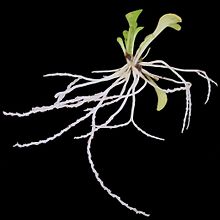
Genlisea are small herbs, growing from a slender rhizome and bearing two morphologically distinct leaf types - photosynthetic foliage leaves aboveground and highly modified subterranean leaves used to trap prey. The plants lack roots, although the subterranean traps perform many of the functions normally performed by roots, such as anchorage and absorption of water and nutrients.
Several to many flowers are held by a slender, erect, and often tall inflorescence. As in other members of the bladderwort family, the corolla is fused into a bilobed tube tapering to a spur, with the lower lip of the corolla having three lobes.[2] The calyx is five-lobed, in contrast to Utricularia's three-lobed calyx.[6] Corolla colors are generally yellow or violet to mauve, although a few species are white or cream.[6]

Depending on species, the photosynthetic leaves are linear to spatulate in shape and 0.5–5 cm (¼–2 in) in length.[2]
The subterranean traps are white, lacking chlorophyll or any other pigmentation. They consist of a cylindrical stalk, widening at some distance below the surface into a hollow bulb-like utricle, and continuing as a hollow cylinder some further distance. At this point the stalk bifurcates into two furrowed spirals, between which the cylinder opening acts as the trap entrance. The furrows of the spiraled trap arms are lined with hairs pointing inward and toward the bifurcation. The hollow cylinder section leading from the bifurcation to the utricle is likewise lined with upward-pointing curved hairs. Some species produce two trap forms, one shorter and one longer, which probably target different prey groups.
Taxonomy
Twenty-nine species are currently recognised in the genus.[7] Two varieties are also considered valid: G. aurea var. minor and the autonymous G. aurea var. aurea.[7] Intraspecific determination depends almost wholly upon the inflorescence, particularly upon the indumentum.[6]
Botanical history
The genus was discovered by Augustin François César Prouvençal de Saint-Hilaire,[2] who in 1833 described four species: G. aurea, G. filiformis, G. pygmaea, and G. violacea.
Genome size range
The genus has a 25-fold range in genome size among its species and notably includes some of the smallest known plant genomes.[5] For example, the genome of G. nigrocaulis is 86 Mbp (1C; 2n = 40) while that of its close relative G. hispidula (1C; 2n = 40) is 1550 Mbp, 18-fold larger. More than one genome size has been measured in G. aurea and G. repens, suggesting that di- and tetraploid individuals exist.[5]